



Reputation Meets Reality: Why P&G’s Rectification Bid Failed
The Madras High Court recently examined a series of rectification petitions filed by The Procter & Gamble Company (P&G) against IPI India Private Limited and another, raising questions on deceptive similarity, descriptive marks, and the limits of exclusivity in trademark law. The dispute centred on whether the respondent’s marks “VAPORIN” and “VAPORIN COLD RUB” unlawfully encroached upon P&G’s well-known mark “VICKS VAPORUB.”
Background of the Dispute
P&G instituted three rectification petitions seeking removal of the following trademarks from the Register of Trademarks:
- Trademark Registration No. 3897775 in Class 03,
- Trademark Registration No. 4285435 in Class 05, and
- Trademark Registration No. 3461733 in Class 03,
all standing in the name of Respondent No. 1, IPI India Private Limited.
Petitioner’s Contentions
P&G contended that it is a globally reputed multinational enterprise, established in 1837, engaged in healthcare and personal care products. Its flagship brand “VICKS,” introduced internationally in 1890 and in India in 1964, enjoys substantial goodwill, reputation, and consumer recognition. According to P&G, its trademarks “VICKS” and “VAPORUB” have been registered globally since 1928, with Indian registrations dating back to 1954 and 1977 respectively and have received consistent judicial protection.
The petitioner asserted that it discovered the respondent marketing similar products under the marks “VAPORIN” and “VAPORIN COLD RUB,” prompting the issuance of a cease-and-desist notice and the filing of rectification proceedings. It was argued that P&G’s rights in “VICKS” and “VAPORUB” predate the respondent’s registrations by several decades.
According to the petitioner, “VAPORUB” and “VAPORIN” are phonetically, visually, structurally, and conceptually similar and, when compared as a whole, are deceptively similar. Given that both parties market identical products through the same channels to the same class of consumers, the likelihood of confusion among consumers with imperfect recollection was said to be inevitable.
P&G further alleged that the respondent’s packaging, trade dress, colour scheme, and overall presentation were deceptively similar to its own and had been adopted with a dishonest intent to ride upon the goodwill and reputation of the “VICKS VAPORUB” brand. It was contended that while “VICKS” functions as the house mark, “VAPORUB” is itself a distinctive product identifier enjoying independent trademark protection and goodwill.
The petitioner also rejected the respondent’s argument that “VAPO” is descriptive and publici juris, pointing out that the respondent’s own mark “VAPORIN” incorporates the same element. According to P&G, the continued presence of deceptively similar marks in the market would dilute its brand equity and goodwill, thereby justifying rectification of the respondent’s registrations.
Respondent’s Defence
The respondent countered by asserting that the petitioner’s products are primarily identified by the house mark “VICKS,” with “VAPORUB” playing a secondary and descriptive role. In contrast, the respondent’s marks “VAPORIN” and “VAPORIN COLD RUB” possess a different structure, phonetic ending, and overall commercial theme, rendering them distinct.
It was argued that the petitioner’s case impermissibly dissected the marks by isolating the common prefix “VAPO,” contrary to settled legal principles requiring marks to be compared as a whole. The respondent maintained that P&G holds no exclusive rights over the descriptive terms “VAPO” or “VAPOUR,” and that the composite mark “VICKS VAPORUB” must be assessed in its entirety, with “VICKS” being the dominant source identifier.
The respondent emphasised that “VAPO” and “Vapour” are descriptive and common to the trade, and that P&G’s own marketing reinforces “VICKS” as the true badge of origin. Since the word “VICKS” is entirely absent from the respondent’s marks, the allegation of consumer confusion was said to be untenable.
It was further contended that “VAPORUB” is merely a combination of the ordinary words “vapour” and “rub,” and that minor spelling variations do not convert a descriptive expression into an invented or distinctive mark. The respondent also argued that P&G’s claim to well-known status does not extend to the descriptive elements “VAPORUB” or “VAPO.”
The respondent highlighted its uninterrupted use and promotion of “VAPORIN” since 2013 without objection from P&G, asserting that such prolonged inaction amounts to acquiescence. Additionally, it was pointed out that parallel infringement proceedings involving the same parties were already pending before the Bombay High Court, which the petitioner had failed to disclose.
To reinforce its case, the respondent relied on multiple registrations for “VAPORIN,” including device and word marks across Classes 3 and 5, obtained between 2017 and 2019, along with evidence of international registrations. The respondent also produced trademark registry records, invoices, and advertisements demonstrating widespread use of “VAPO”-prefixed marks by numerous third parties, underscoring that such terms are common to the trade and cannot be monopolised by a single market player.
Court’s Analysis and Findings
Upon examining the material on record, the High Court found that the respondent had established extensive and bona fide use of “VAPORIN,” alongside evidence of numerous third-party products employing the prefix “VAPO.” The Court noted clear differences in the names, packaging, colour schemes, sizes, lettering, and overall presentation of the rival products, which dispelled any claim of deceptive similarity.
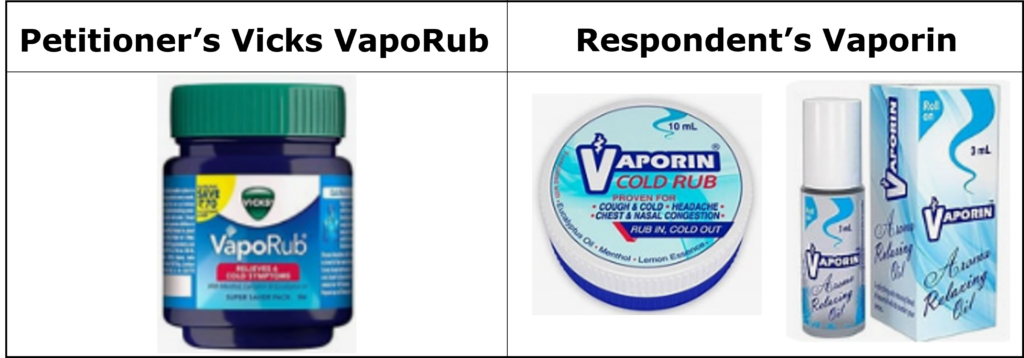
The Court reiterated that trademarks must be compared as a whole, from the perspective of an average consumer with imperfect recollection, and not by dissecting individual components. When viewed in their entirety, “VICKS VAPORUB” and “VAPORIN/VAPORIN COLD RUB” were found to be neither phonetically nor visually similar, and unlikely to mislead consumers into believing that the respondent’s products originated from P&G.
The Court accepted the respondent’s contention that “VAPO” is merely an abbreviation of “vapour,” descriptive in nature, and publici juris. Consequently, its use could not give rise to deceptive similarity or confer exclusivity. The widespread presence of “VAPO”-based products in the market further negated any allegation of dishonest adoption by the respondent.
Conclusion
In light of these findings, the High Court dismissed the rectification petitions filed by The Procter & Gamble Company, holding that the respondent’s marks were distinct, honestly adopted, and not deceptively similar to “VICKS VAPORUB.” The decision reinforces the principle that descriptive and common-to-trade elements cannot be monopolised, and that trademark rights must be assessed holistically rather than through selective dissection.