



“NOVARTIS vs. NOVIETS: Too Close for Comfort in Pharma Branding”
A contentious trademark dispute before the Delhi High Court between Novartis AG and the “Noviets” group of entities has resulted in the grant of an interim injunction restraining the Defendants from using the mark “NOVIETS.” The case presents a conflict involving allegations of trademark infringement, passing off, unfair competition, dilution, etc, in the pharmaceutical sector where courts consistently apply an enhanced standard due to public health implications. This note discusses the rival submissions of the parties and the Court’s ruling on the interim injunction application.
Background and Plaintiff’s Case
The Plaintiffs, forming part of the globally renowned Novartis Group, asserted longstanding rights in the mark “NOVARTIS,” adopted in 1996 and used extensively across jurisdictions, including India. With a presence in India dating back to 1947, the Plaintiffs emphasized their substantial goodwill, extensive sales, and significant promotional activities.
The “NOVARTIS” mark, serving as a house mark, has acquired distinctiveness and source-identifying significance. The Plaintiffs contended that the Defendants’ mark “NOVIETS,” used in relation to pharmaceutical and veterinary products, is deceptively similar, visually, phonetically, and structurally.
The dispute traces back to October 2020, when the Plaintiffs discovered the Defendants’ trademark application for “NOVIETS.” Despite issuing multiple legal notices and initiating opposition proceedings which led to abandonment of the application, the Defendants continued their use. In January 2024, the Plaintiffs discovered the Defendants’ products bearing the impugned mark on IndiaMart, prompting the present suit.
The Plaintiffs argued that:
- The marks ‘NOVARTIS’ and ‘NOVIETS’ are deceptively similar and used for identical goods.
- The Defendants’ adoption is dishonest and intended to ride on the Plaintiffs’ goodwill.
- In pharmaceutical cases, even a likelihood of confusion is sufficient due to potential public health risks.
- Interim injunction can be granted even against a registered mark if prior rights are established.
Defendants’ contentions
The Defendants resisted the injunction on several grounds:
- Lack of territorial jurisdiction, asserting no commercial activity in Delhi and their IndiaMart listing as passive.
- Distinctiveness of the mark “NOVIETS,” arguing that “NOV” is a generic prefix widely used in the pharmaceutical trade.
- Bona fide adoption and limited use as a trade name rather than a product mark.
- Absence of confusion, misrepresentation, or damage, given their localized, offline operations.
Court’s Analysis and Findings
Jurisdiction
At the interim stage, the Court applied the demurrer principle, accepting the plaint’s averments as true. It held that the Defendants’ IndiaMart listing and “Contact Us” page indicating Delhi as a place of business prima facie established purposeful targeting of consumers within Delhi.
The Court observed that the determination of whether the online presence is “passive” or “interactive” involves a mixed question of law and fact and therefore cannot be conclusively decided at the preliminary stage.
Deceptive Similarity and Dishonest Adoption
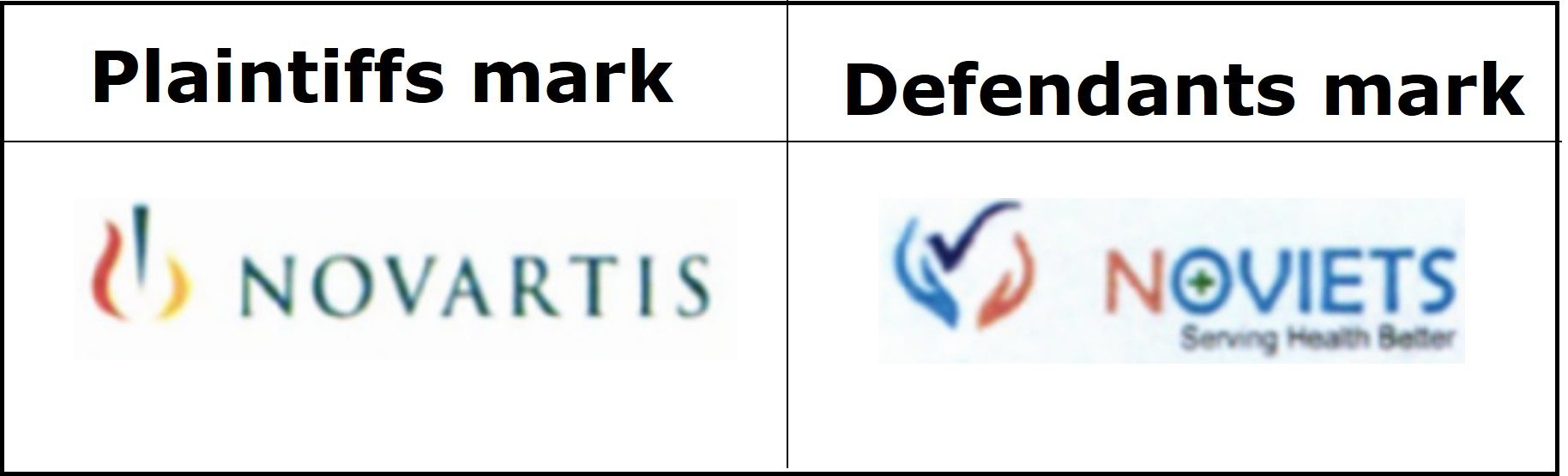
The Court found a strong prima facie case of deceptive similarity:
- Both marks share the dominant element “NOV”
- Structurally and phonetically, “NOVARTIS” and “NOVIETS” are similar.
- Minor variations were held insufficient to dispel confusion.
Applying the dominant feature test, the Court held that the essential feature of the Plaintiffs’ mark had been appropriated.
The Defendants’ argument that “NOVIETS” was used only as a trade name was rejected, with the Court clarifying that such use does not safeguard against infringement or passing off.
Further, the Court noted the absence of any plausible explanation for the adoption of the mark “NOVIETS,” concluding that the adoption was prima facie dishonest and intended to capitalize on the Plaintiffs’ reputation.
Goodwill, Confusion, and Public Interest
The Plaintiffs successfully demonstrated substantial goodwill and reputation. The Court emphasized that:
- Actual confusion need not be proven; likelihood of confusion suffices.
- From the standpoint of an average consumer with imperfect recollection, the marks are nearly indistinguishable.
- In pharmaceutical cases, stricter scrutiny is warranted due to risks to public health.
Generic Defence Rejected
The Defendants’ argument that “NOV” is generic was dismissed. The Court observed that having themselves sought registration of “NOVIETS,” the Defendants could not simultaneously claim that the mark lacks distinctiveness.
Triple Identity and Balance of Convenience
The Court found the presence of “triple identity”, similar marks, identical goods, and overlapping consumer base, strongly favouring the Plaintiffs.
On the balance of convenience, the Court held that:
- Continued use by the Defendants would irreparably harm the Plaintiffs’ goodwill.
- The Plaintiffs had established a strong prima facie case.
- Irreparable injury would ensue absent interim relief.
Conclusion
The Delhi High Court granted an interim injunction restraining the Defendants from using the mark “NOVIETS” or any deceptively similar mark in relation to pharmaceutical and veterinary products, whether as a trademark or trade name.
The case is a reaffirmation of the enhanced protection accorded to pharmaceutical trademarks and the judiciary’s role in preventing consumer confusion in matters impacting public health.