



From Red Bottles to Court Battles: Trade Dress Turbulence in the Cooling Oil Market
A significant dispute in the FMCG sector arose between Emami Limited and Dabur India Limited, with allegations that Dabur had adopted a deceptively similar trade dress in the cooling oil segment. Aggrieved by what it alleged as a calculated attempt to ride upon its market reputation, Emami instituted a passing off action seeking injunctive relief to restrain the use of the impugned packaging, asserting that it substantially mirrors the distinctive and long-established get-up of its flagship product, Navratna Oil, and is likely to mislead consumers while diluting its valuable goodwill.
Background and Emami’s Case
Founded in 1974, Emami is a leading Indian manufacturer of health, beauty, and personal care products. Its flagship product, Navratna Oil  , was launched in January 1989 with the tagline “Thanda Thanda Cool Cool” and has remained in continuous use since then. Emami claims market leadership in the therapeutic cooling oil segment and asserts that its marks NAVRATNA, NAVRATNA OIL, and variations of “Cool Cool” and “Thanda Thanda” are registered and widely recognized.
In addition to trademark protection, Emami holds design registrations for its bottle under the Designs Act, 2000, and copyright registrations for the product label. Through extensive advertising and promotion over more than three decades, the brand has acquired substantial goodwill and household recognition.
In June 2023, Emami discovered that Dabur had launched a competing cooling oil product packaged in red bottles allegedly resembling Emami’s trade dress. According to Emami, Dabur’s packaging mirrors its distinctive combination of red colour scheme, bottle shape, flip-cap, liquid colour, layout, ingredient imagery (hibiscus, ice cubes, herbs), descriptive expressions, and overall visual presentation  . Emami contends that this constitutes slavish imitation designed to create consumer confusion and falsely suggest association.
Emami further argues that Dabur has taken inconsistent positions claiming Emami’s trade dress is common to trade while simultaneously asserting distinctiveness and seeking registration of its own packaging. It maintains that mere reliance on third-party registrations is insufficient to establish commonness without proof of substantial market use.
Dabur’s Defence
Dabur resisted the injunction on multiple grounds. It contended that its prominent house mark “DABUR” clearly distinguishes its product, eliminating any likelihood of confusion. It further argued that Emami failed to establish goodwill in the specific trade dress relied upon, as its sales and advertising figures pertain to the broader NAVRATNA brand rather than the particular packaging in question.
Dabur maintained that a holistic comparison reveals substantial differences in bottle design and packaging. The alleged similarities, according to Dabur, are limited to common or functional elements such as the colour red, hibiscus flowers, ice imagery, menthol leaves, and descriptive terms like “THANDA” and “COOL,” all of which are generic and common to trade.
Additionally, Dabur asserted prior use and statutory rights in relation to red-coloured oils, citing longstanding registrations including “DABUR LAL TAIL,” “HIM SAGAR,” and “SUPER THANDA OIL.” It argued that Emami is not the first adopter of red packaging in cooling oils and that Emami’s trade dress dates only from 2016 in its present form.
Emami’s Rejoinder
In response, Emami contended that Dabur offered no bona fide explanation for abandoning its earlier packaging and adopting a trade dress closely resembling Emami’s. The absence of commercial justification, it argued, supports an inference of dishonest adoption.
Emami clarified that it does not claim exclusivity over individual elements like red colour or herbal imagery, but over their distinctive combination and presentation, which has acquired secondary meaning through long-standing use. It emphasized that deception must be assessed on the overall impression at the point of sale and that the mere presence of the house mark “DABUR” cannot neutralize the confusing similarity in the overall get-up.
Court’s Analysis and Findings
The Court confined its examination to whether Dabur’s trade dress amounted to passing off. Reiterating settled principles, the Court held that in a packaging based passing off action, the plaintiff must demonstrate that its get-up is distinctive and that the defendant’s packaging is deceptively similar, such that consumers are likely to be misled. The assessment must be holistic, focusing on overall impression rather than isolated differences.
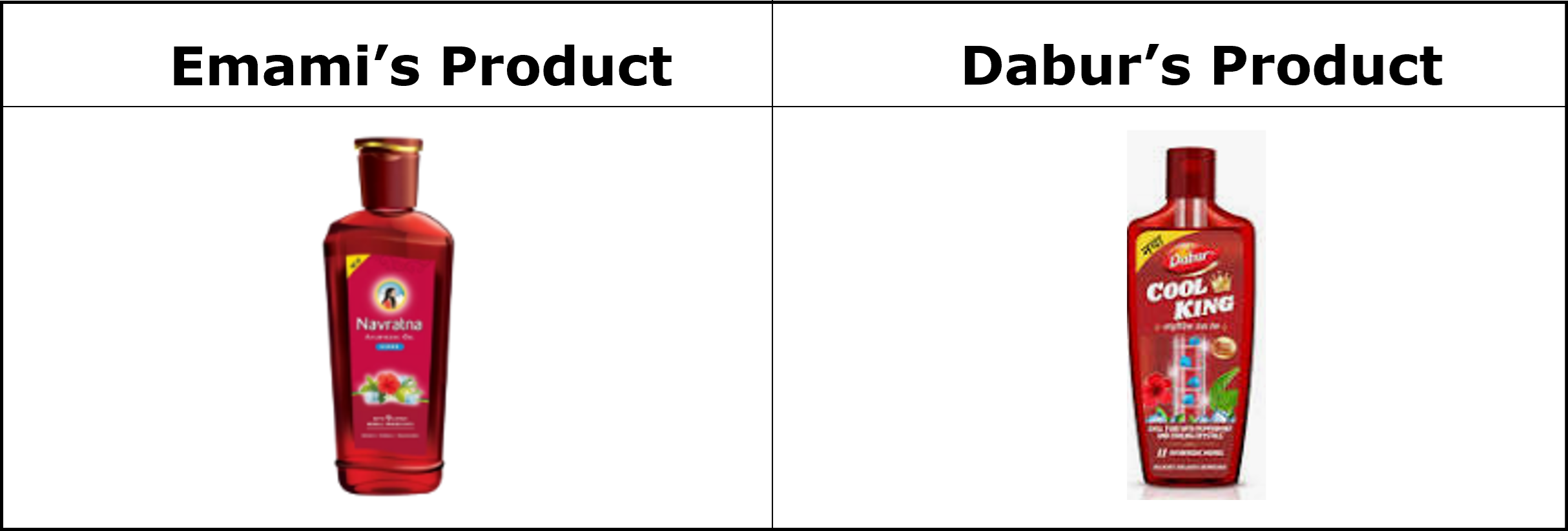
Upon comparison, the Court found that Dabur’s packaging imitated the essential features of Emami’s trade dress. The shared red colour scheme, bottle shape, cap and liquid colour, combination of red, white, yellow and gold, imagery of hibiscus and ice cubes, identical expressions in the same sequence, and even the identical 270 ml quantity indicated deliberate imitation rather than coincidence. Minor differences were held insufficient to outweigh the dominant similarities.
The Court further held that Emami had prima facie established goodwill through continuous use since 1989 and substantial sales turnover. As Dabur’s product was launched only in 2023, it could not deny Emami’s established market reputation.
While Emami could not claim monopoly over individual components such as red colour or herbal imagery, the Court recognized that their distinctive combination and ensemble had acquired secondary meaning and merited protection. Reliance on third-party registrations without proof of actual market use was found inadequate.
Conclusion
Finding that Emami had established the ingredients of passing off, goodwill, misrepresentation, and likelihood of damage the Court granted an injunction restraining Dabur from selling its product “Cool King Thanda Tael” in the impugned or any deceptively similar trade dress.
The decision underscores the importance of holistic comparison in trade dress disputes and affirms that even common elements, when combined in a distinctive and long-used ensemble, can acquire protectable goodwill under the law of passing off.