



Indian Patent Office Issues Guidelines on the Use of Artificial Intelligence in Patent Examination
Executive Summary: The Indian Patent Office has introduced a structured framework for the responsible use of artificial intelligence in patent examination. AI may support classification, prior-art searches, translation, technical analysis and drafting, but every output must be treated as preliminary and independently checked. Confidential or unpublished information must not be entered into public AI tools, and AI cannot replace the judgment of an Examiner or Controller. For businesses and patent applicants, the key message is that AI may make examination more efficient, while human oversight, confidentiality and accountability remain essential.
The Office of the Controller General of Patents, Designs and Trade Marks (CGPDTM) has issued Guidelines for the responsible use of artificial intelligence in patent examination. The framework seeks to improve efficiency and quality while preserving confidentiality, accountability, consistency and the independent application of mind required from the Examiner or Controller.
Why the Guidelines Matter?
Patent examination involves large volumes of technical and legal material and is often time-sensitive. AI can help examiners organise information, develop search strategies, identify relevant documents and prepare draft communications. The Guidelines are intended to capture these efficiency gains without compromising confidentiality, accuracy, consistency or accountability.
In practical terms, the Guidelines allow AI to support the process, while keeping substantive decisions firmly with the Examiner or Controller.
Where AI May Be Used?
Within this framework, AI may assist with the following patent examination activities:
- Screening of documents;
- Patent classification;
- Prior-art searching;
- Translation support;
- Drafting support;
- Technical comparison; and
- Knowledge retrieval.
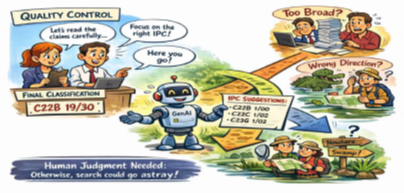
The Guidelines distinguish between public AI tools, which are generally available through consumer-facing platforms, and private AI tools, which operate in controlled environments with stronger safeguards for proprietary or sensitive information.
Key Risks to Manage
Because AI outputs can be influenced by previous interactions, prompt design and model-specific behaviour, different tools may produce materially different results for the same patent application or prior-art material. The Guidelines therefore identify the following key risks:
- Hallucinations or fabrication of information;
- Omission of critical claim details;
- False pattern matching between claims and prior art;
- Loss of technical context during summarisation or translation;
- Search and classification drift;
- Overly broad or narrow interpretations;
- Lack of transparency in AI reasoning;
- Confidentiality risks;
- Misguidance through persuasive but incorrect reasoning;
- Use of incomplete or outdated information;
- Bias arising from training data; and
- Difficulty in understanding specialised patent language and legal nuances.
The Guidelines caution that AI tools may generate non-existent citations, misrepresent judicial precedents, incorrectly map claim features to prior-art disclosures, or provide persuasive conclusions that are technically or legally unsound.
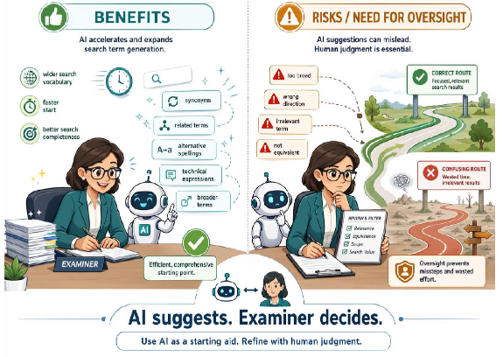
Human Oversight Remains Essential
AI may support the Examiner or Controller, but it cannot replace their judgment. All AI-generated output must be independently reviewed before use, and the human decision-maker remains fully responsible for every official action.
The Guidelines require that all AI-generated outputs be critically assessed for correctness, relevance and appropriateness before adoption in any official process.
Permitted Uses of AI
The Guidelines identify several areas where AI may be used as an assistive tool, subject to appropriate safeguards.
AI may assist in identifying candidate IPC or CPC classifications, generating search terms and concept clusters, extracting claim features for preliminary analysis, supporting translation of foreign-language documents, improving the language and structure of draft communications, identifying legal and technical references, conducting preliminary novelty or inventive-step assessments, identifying potential clarity issues and assisting with sufficiency reviews.
These uses are subject to safeguards. Classification, searches, translations and citations must be independently checked, and any conclusions on novelty or inventive step must be based on the Examiner’s own analysis.
The Guidelines further observe that even sophisticated AI systems can produce inconsistent results. The annexures provide examples where different AI models generated different classification codes, different search vocabularies and even contradictory novelty analyses for the same patent claim, thereby illustrating the continuing necessity of human evaluation.
Prohibited Uses
The Guidelines expressly prohibit the following uses of AI:
- Entering unpublished patent applications, confidential office material or internal records into public AI tools;
- Using AI as a substitute for the Examiner’s or Controller’s judgment on substantive matters such as novelty, inventive step, sufficiency, clarity, industrial applicability or unity of invention;
- Issuing FERs, hearing notices, decisions or official communications solely on the basis of AI-generated outputs;
- Relying upon AI-generated citations without independent verification from authentic sources;
- Using AI-generated content in official communications without review and validation; and
- Allowing AI to make decisions affecting the rights of applicants, patentees or third parties.
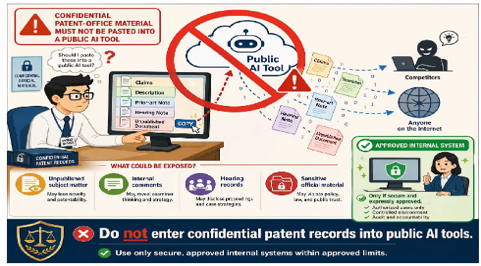
The Guidelines stress that confidentiality concerns are particularly significant in relation to unpublished patent applications and that care must be taken to avoid disclosure of such material through public AI systems.
Governance and Internal Controls
To promote responsible use of AI, the Guidelines contemplate the establishment of governance mechanisms that may include record-keeping of AI usage, oversight committees, approval of AI tools, periodic policy review, quality monitoring, training programmes and audit mechanisms. Training initiatives may specifically focus on understanding AI limitations, confidentiality risks, prompt discipline, hallucination detection and verification of AI-assisted outputs.
What This Means for Businesses?
The Guidelines should support a more efficient and technology-enabled patent examination process, particularly for searching, classification, translation and document review. Businesses should nevertheless expect patentability assessments and official decisions to remain human-led. Applicants should continue to submit clear, accurate and well-supported patent specifications, protect confidential information carefully, and avoid assuming that AI-generated analysis will be accepted without independent verification.
The content and images are drawn from the guidelines issued by the CGPDTM (ZN0Nk7Z9dXPr0C5vu3zjj1c8cPsRfX1SlxORk0Ke.pdf)