



Exide v. Amara Raja: Courts Reinforce Protection for Distinctive Product Get-Up
This dispute concerns two leading battery manufacturers-Exide Industries Limited (“Exide”) and Amara Raja Energy and Mobility Limited (“Amara Raja”) and centers on Amara Raja’s alleged imitation of Exide’s distinctive trade dress and resulting passing off. The key question before the Calcutta High Court was whether Amara Raja’s adoption of a similar red-and-white color scheme, packaging style, visual elements, and overall product presentation was likely to confuse consumers and unfairly appropriate the goodwill built around Exide’s well-established brand identity. The High Court found that Exide had established a strong prima facie case and granted interim relief. On appeal, the Supreme Court partly modified the injunction by permitting sale of existing stock already supplied to distributors and retailers, while restraining sale of batteries still in Amara Raja’s possession unless repackaged in a non-red, non-infringing trade dress and directing destruction of unused red cartons bearing the impugned get-up.
Background
- Exide Industries Ltd., a leading manufacturer of lead-acid batteries with a market presence dating back to 1920, instituted proceedings for trademark infringement and passing off against Amara Raja.
- Exide relied on its long-standing use of the EXIDE mark, its predominantly red trade dress, red-and-white color combination, registered “EL” mark, and copyrighted “shattered O” device
 , all of which it asserted had acquired substantial goodwill and operated as source identifiers.
 - Amara Raja, a major competitor known for marketing its batteries under the AMARON brand with a predominantly green trade dress, launched a new battery called “ELITO” in India.
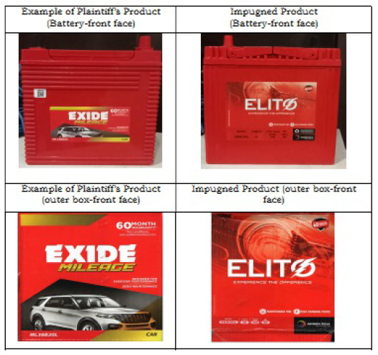
- Although ELITO had initially been introduced in overseas markets in blue packaging, Amara Raja adopted a red-and-white trade dress for the Indian market, incorporating the letters “EL” and a shattered “O” device. Exide alleged that these elements closely mirrored its own trade dress.
- Exide contended that Amara Raja deliberately abandoned its long-standing branding to imitate Exide’s established market identity and mislead consumers.
Key Issues
- Whether Amara Raja’s use of the ELITO mark, red-and-white trade dress, “EL” letters, and shattered “O” device amounted to passing off and trademark infringement.
- Whether Exide had established sufficient goodwill and distinctiveness in its trade dress and associated elements to warrant protection.
Exide’s Submissions
- Exide argued that it had built enormous goodwill through more than a century of continuous use of the EXIDE mark and its distinctive red trade dress.
- It submitted that consumers had come to associate the red-and-white color combination, the “EL” mark and the shattered “O” device exclusively with Exide.
- Exide submitted that Amara Raja had adopted several distinctive features in combination, including the predominant red color, similar shape and size of the batteries, five-letter word format, “EL” element, shattered “O”, and overall get-up, thereby creating a deceptive overall impression.
- Exide also emphasized that Amara Raja had historically identified itself with green and had previously criticized red in its advertising, making its sudden adoption of red trade dress suggestive of dishonest intent.
- Exide argued that passing off must be assessed based on the cumulative impact of the overall trade dress rather than by comparing individual elements separately.
Amara Raja’s Submissions
- Amara Raja argued that Exide had failed to establish the essential ingredients of passing off, namely goodwill, misrepresentation and damage.
- Amara Raja submitted that no trader could claim a monopoly over the color red, which was commonly used in the battery industry.
- Amara Raja maintained that batteries are expensive products purchased with considerable care, making consumer confusion unlikely.
- Amara Raja argued that the ELITO mark was visually and phonetically distinct from EXIDE.
- Amara Raja explained that it moved from blue to red packaging because distributors considered the blue packaging insufficiently visible in a crowded marketplace. It denied any intent to imitate Exide.
Court’s Reasoning and Decision
- The Court held that Exide was not claiming a monopoly over the color red alone, but protection for the overall combination of its red trade dress, “EL” mark, shattered “O” device, and product presentation.
- It found that Exide had built substantial goodwill through long and extensive use and accepted at the interim stage that consumers associated red with Exide and green with Amara Raja.
- Amara Raja’s explanation for shifting from blue to red packaging was considered inconsistent, particularly as blue packaging continued internationally while the Indian packaging alone was changed to red.
- Viewing the competing products, the Court found that Amara Raja’s combined use of similar visual elements was likely to cause confusion among ordinary purchasers with imperfect recollection.
- The Court therefore held that Exide had made out a strong prima facie case for passing off, with the balance of convenience in its favor and a likelihood of dilution of goodwill if interim protection was denied.
- Accordingly, it granted an interim injunction restraining Amara Raja from using the impugned trade dress and associated indicia, later extending the compliance period to three months from the date of the order.
Supreme Court’s Interim Order dated May 27, 2026
Amara Raja appealed to the Calcutta High Court’s order dated July 24, 2025 before the Supreme Court. By its interim order dated May 27, 2026, the Supreme Court partly allowed the appeal and modified the High Court’s injunction after considering Amara Raja’s affidavit on remaining stock. The Court noted that manufacturing had stopped before the injunction came into effect and that a substantial number of batteries were lying with distributors, retailers, and Amara Raja itself.
The Supreme Court held that batteries still in Amara Raja’s possession could not be sold in the disputed red trade dress and could be marketed only after being repackaged in a non-red trade dress that did not resemble Exide’s. It also directed that unused red cartons bearing the impugned trade dress be destroyed. However, recognizing that batteries already supplied to distributors and retailers were no longer within Amara Raja’s control, the Court permitted sale of that existing stock. The Court clarified that these directions were confined to the interim injunction and would not influence final adjudication of the trademark and trade dress dispute before the High Court.
Key Takeaway
The decision reinforces that trade dress protection is not confined to individual marks or isolated colors but may extend to the overall visual presentation of a product where that presentation has acquired distinctiveness and goodwill. For brand owners, the ruling reinforces the value of consistently using distinctive product get-up and the importance of acting promptly against lookalike packaging. For competitors, it serves as a reminder that adopting a rival’s distinctive combination of visual elements, even without copying a mark verbatim, may invite injunctive relief where it creates a likelihood of confusion.